For brands: Kickstarter ad briefs
Kickstarter ads and Kickstarter advertising, the Facebook ad brief built around your real prototype
Most crowdfunding campaigns live or die on paid social. The page, the video and the reward tiers matter, but the backers who fill the first 48 hours often came from a Meta ad that collected their email weeks earlier, and many of the pledges after day three come from ads too.
The trouble is the creative. Founders film the hero video once, cut it into ads, and discover that a two minute story about why they started does not stop anyone on Instagram. Agencies fix this, at retainer prices. A brief fixes most of it for the price of a lunch: what to show in the first two seconds, which prototype shot proves the claim, and what to ask the viewer to do this week.
written brief, AI-labelled, you hire the creator
Creator persona
First 3 seconds
On-screen text
Yours to use commercially
- Format
- Includes
- Hook, scenes, CTA
We write the brief and the script. You hire the creator yourself.
Generate a briefThe short answer
A Kickstarter ad that funds a campaign is almost always a short Facebook or Instagram video of the real prototype doing its one job, filmed on a phone, with one ask that matches the campaign stage: join the pre-launch list before launch, pledge once you are live. Kickstarter's own rules say a prototype demonstration "should reflect a product's current state and should not include any CGI or special effects to demonstrate functionality that does not yet exist", so the ad has to be built from footage of what actually works today. UGCMarketplace writes that brief and script from a product description: the hook, the timed prototype shots, the ask for your stage and the creator to cast. The first brief needs no account, and Pro is $49 a month for unlimited briefs.
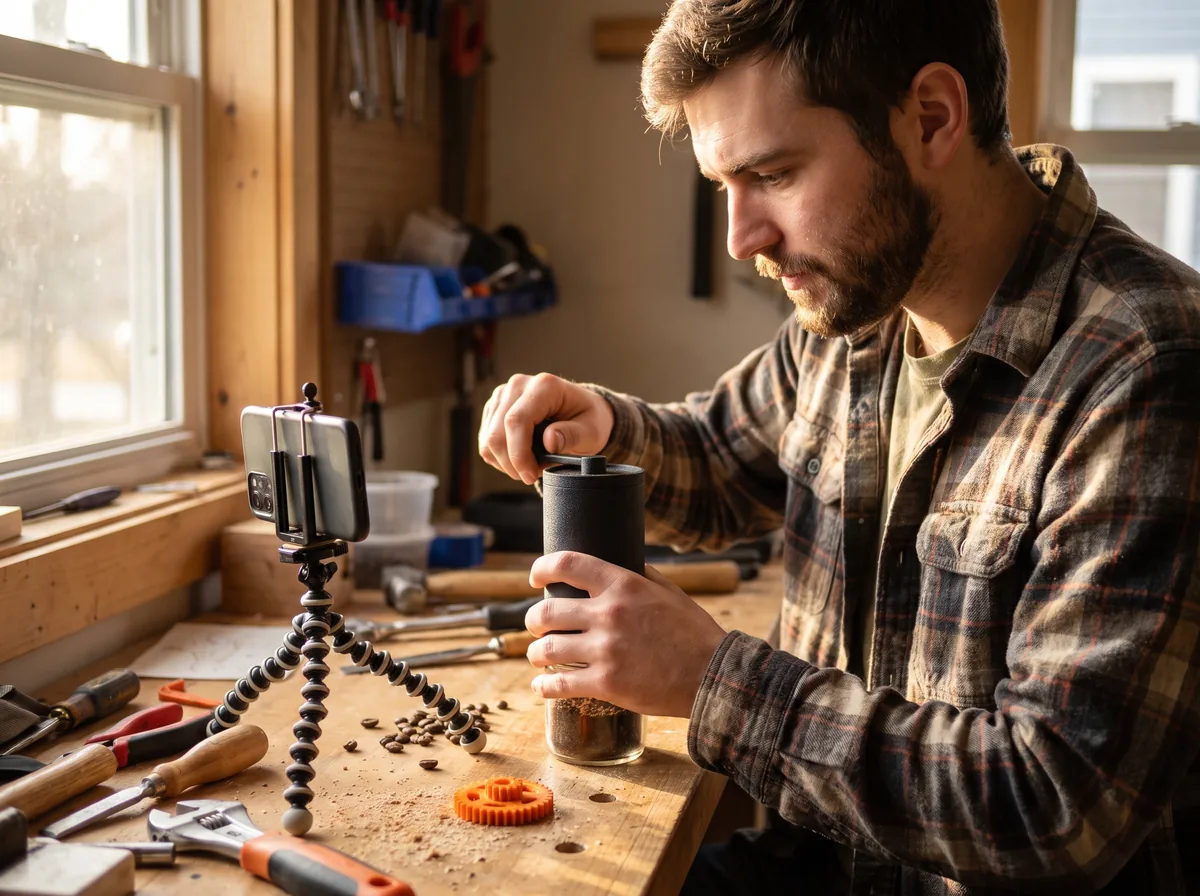
What the brief asks for
The real prototype, in real hands, doing the one thing it does.
- The product working in the first two seconds, because a backer is buying proof that it exists
- Honest workshop light and a real bench, which reads as a real team and not a render
- Every function on screen shown as it works today, with anything unfinished said out loud
- A phone on a small tripod at 9:16, so the same take cuts into Reels, Stories and feed
Brief in a minute
First one free
Why it works
What you get with Kickstarter ad briefs
Built from the prototype you have
The shot list only uses functions that work on camera today, which is what Kickstarter rules require, and flags anything the creator should describe as in development.
The right ask for the stage
Pre-launch ads ask for an email or a follow. Live ads ask for a pledge and name the reward. The script changes with your campaign stage, not just the caption.
Try it before you pay
The first brief needs no account. Pro is $49 a month for unlimited briefs and scripts with clean downloads.
What it covers
The brief, the hook, and the shot-by-shot script
UGCMarketplace turns a product description into a written brief and video script you can hand to a creator you hire. It writes the words; you hire the creator.
- Get a hook built on the prototype working in the first two seconds, with two alternates to test
- Get the timed scenes, the voiceover and the on-screen text for sound-off viewing
- Get a pre-launch version that asks for the signup and a live version that asks for the pledge
- Get a 9:16 spec for Reels, Stories or Meta feed, plus TikTok and Shorts cuts
- Get a profile of the creator to cast, and the usage rights to agree before filming
- Brief
- Kickstarter ad briefs
- Creator to recruit
- Persona + where to find them
- Format
- Vertical 9:16, 0:25
- Script
- Hook, timed scenes, CTA
- Delivered in
- About a minute
What you get
Yours to useAn example of the written brief and script the generator produces. You take it to a creator you hire yourself.
In depth
What to know about Kickstarter ads
What makes Kickstarter ads work on Facebook and Instagram?
Proof, stage and one ask. Someone scrolling Instagram has never heard of your project, cannot touch the product, and has been burned by at least one crowdfunding campaign that never shipped. The ad has to show the thing working, fast, and then ask for exactly one small action.
That is why phone-shot creator video tends to beat the polished hero film in paid placements. The hero video is built for a visitor who already chose to open the campaign page and will give it two minutes. A cold ad gets under three seconds before the thumb moves, so it opens on the result: the grinder filling the cup, the backpack opening flat on an airport floor, the board game's best turn in one move.
The second thing that matters is the stage. A campaign has two very different advertising jobs, and the most common mistake we see in crowdfunding Facebook ads is running live-campaign creative before launch or the other way round. Our UGC briefs for Meta ads cover the placement rules that apply to both.
What do Kickstarter rules say about prototype videos?
More than most founders read before they film. The Design and Technology section of the Kickstarter rules says a prototype demonstration "should reflect a product's current state and should not include any CGI or special effects to demonstrate functionality that does not yet exist". It adds that where a project needs software and hardware to work together, creators "are required to show that functionality and any dependency clearly, or disclose that it has not yet been developed". Apps and software projects must demonstrate a prototype too.
The same rules page has a section on AI. It says "Creators must be transparent about how AI is used", that excessive use with "little to no human thought or human involvement" is prohibited, and that as long as there is human creativity and involvement, AI use is permitted. The general line underneath all of it is short: "Projects can't mislead people or misrepresent facts."
For advertising this has a practical consequence. The ad sends people to a page that has to follow those rules, so an ad showing a feature the prototype video does not show sets up a backer who feels misled on arrival. A creator improvising "it charges in ten minutes" is the same problem in spoken form. Every claim in our script comes from the facts you enter, and anything you mark as not built yet is written as in development.
Pre-launch ads or live campaign ads, which creative for which?
Different ask, different hook, often a different creator take. This is how we split the two in a brief.
| Stage | What the ad asks for | Opening two seconds | Where it sends people | What to change weekly |
|---|---|---|---|---|
| Pre-launch, weeks before | An email or a follow, so they are notified on launch day | The problem or the product working, no price yet | Your signup page or the Kickstarter pre-launch page | Hooks, while the body stays the same |
| Launch window, first 48 hours | Pledge now for the early bird tier | The product working plus the early bird reward | The live campaign page | Nothing, you are harvesting the list |
| Live campaign, day 3 onward | Pledge, with a reason to do it this week | Proof of demand, such as percent funded, then the product | The live campaign page | The reason: a stretch goal, an add-on, the deadline |
| Final days | Pledge before it ends | The deadline and the product in one frame | The live campaign page | Countdown framing only |
Because the prototype footage is the expensive part, the brief asks the creator to film the product sequence once and record several spoken openings and asks around it. One shoot then covers the whole campaign. Our ad hooks page explains how to brief those alternates so they are a real test and not the same line reworded.
How do you film a prototype for a Kickstarter ad?
Close, well lit, in use, and without hiding the rough edges. Prototypes look like prototypes, and backers expect that. What they do not forgive is a shot that looks staged to hide something.
The shot list we write for a hardware or product-design project usually has five parts: the result shot for the hook, the product in a hand for scale, the one mechanism that makes it different shown in real time with no speed ramp, a short sequence of normal use in a real place, and the creator's reaction or a spoken line that states the promise plainly. Where your project needs an app or firmware to do its job, the brief puts the phone screen and the device in the same frame, which is exactly what the rules ask for when hardware and software depend on each other.
Two things we tell creators every time. Film the prototype you will show on the campaign page, not a newer or older one, so the ad and the page agree. And if a function works but is slow, show it at real speed and say so, because a sped-up clip is a special effect in all but name. For product-in-hand technique in general, see our product demo video briefs.
Should the founder or a creator be in the Kickstarter ad?
Usually both, in different ads. Crowdfunding is one of the few categories where the founder on camera is a selling point, because backers are funding a team as much as a product. A founder explaining why they built it is often the strongest ad for a warm audience, such as your pre-launch list or people who watched the page video.
For cold audiences a creator who fits the buyer tends to do better, for the same reason UGC works everywhere else: they look like the person scrolling, and they react to the product the way a customer would. A camping product shot by someone who actually camps reads as proof in a way a founder in a studio cannot.
The brief covers both. It writes the founder version with the origin line kept to one sentence, and the creator version with a profile of who to cast, what they must show, and the words they cannot say. If you are hiring creators for this, our page on hiring UGC creators covers the rights to agree before anyone films, since campaign ads usually run for weeks.
What should a Kickstarter ad brief include?
Everything a creator would otherwise guess. A brief that is only "show the product, keep it authentic" gets you a clip you cannot run on a campaign page. This is what the generator writes for a crowdfunding project.
| Section | What it says | Why it matters for crowdfunding |
|---|---|---|
| Objective and stage | Pre-launch signup, launch pledge or live pledge | The ask changes the whole script |
| Hook and two alternates | The opening line and the first shot | Cold audiences decide in under three seconds |
| Prototype shot list | Each shot with timing, light and framing | Only what works today, per the platform rules |
| What works and what is in development | Your list, word for word | Stops a creator from promising unbuilt features |
| Voiceover and on-screen text | Lines timed to the shots | Most feed video is watched with the sound off |
| The offer | Early bird tier, reward or deadline you give us | A reason to act this week |
| Technical spec | 9:16, length, safe zones for Reels and Stories | Captions and the ask stay clear of the interface |
| Creator profile and usage | Who to cast, how long you can run the ad | Campaign ads run for weeks, not days |
The script itself follows the structure on our video ad script page: hook, proof, ask, in that order and inside the length you pick.
How long should a Kickstarter video ad be?
Fifteen to thirty seconds for cold traffic, longer for people who already know the project. The platforms allow far more: Meta's ads guide lets Instagram Reels ads run up to 15 minutes and sets no maximum for Facebook Reels. Length is not the constraint. Attention is.
A useful rule for crowdfunding is one idea per ad. The 20 second cold ad proves the product works and asks for the signup. A 45 to 60 second warm ad can carry the founder's reason, a second use case and the reward tiers, because the viewer has already opted in. The hero video on the campaign page is a third asset with a third job, and it does not need to be cut down to serve as an ad.
If you plan to run the same footage as Reels, check the safe zone before the creator films: Meta's guide keeps the top 14 percent and the bottom 35 percent of a 9:16 frame clear of key text. Our Instagram Reels ads page has the full spec.
What hooks work for crowdfunding Facebook ads?
Hooks that prove the product exists and is different, before anything else. These are the openings we write most often for crowdfunding Facebook ads, and when each one fits.
| Hook type | First line or first shot | Best for |
|---|---|---|
| Result first | The finished output, then the product that made it | Kitchen, tools, gadgets |
| Size reveal | The folded product in one hand, then fully open | Travel, outdoor, furniture |
| The annoying old way | Two seconds of the current workaround, then yours | Anything that replaces a habit |
| Maker on the bench | The founder holding the prototype, one sentence on why | Warm audiences, design objects |
| One move | The single best moment of play or use, uncut | Board games, toys, sports gear |
| Social proof | The funded percentage or backer count on screen | Live campaigns after day three |
The last row only works once you have the numbers, and it has to be the real figure from your campaign page. The brief pulls it from the facts you enter and never estimates it. If you are also weighing whether to hand the whole program to a specialist, our breakdown of Kickstarter marketing agency pricing compares what those firms publish.
Why UGCMarketplace
Written, specific, and ready to hand over
Not a blank document, not a vague one-line brief, not a slow agency round trip. The brief and the script, written in about a minute.
The persona to recruit
The archetype, niche, account signals, search terms and outreach angle for the creator to look for. Finding and hiring them is your job, not ours.
Briefs you own
The briefs and scripts you generate are yours to use commercially. We claim no ownership and we do not resell your inputs.
Written for the platform
Pick TikTok, Reels, Shorts or Meta and the script, length and technical specs are written for that format.
Good questions
Questions about Kickstarter ad briefs
Explore more
More UGC briefs and scripts you can generate here
UGC for beauty brands
Get a beauty UGC brief and script built around the payoff moment your product delivers.
Learn more →UGC video production
Get the brief and script that starts UGC video production, no studio required.
Learn more →UGC for supplement brands
Get a supplement UGC brief built around a structure-function claim you can substantiate.
Learn more →Get the brief written, free.
Describe your product and get the brief, the hook, the scene-by-scene script and the creator persona to recruit. First one needs no account.
written brief, AI-labelled, you hire the creator