For brands: Jewelry ad briefs
Jewelry ads and jewelry advertisement videos, briefed for the creator who films them
Jewelry is the hardest product in ecommerce to show on a phone. The piece is tiny, it reflects everything in the room, and a flat studio shot on white tells the buyer nothing about how big it is on a real hand.
So most brands hand a creator the product and say "film a try-on". What comes back is a pretty clip with the ring out of focus, the chain lost against a patterned top, and a voiceover calling a plated piece "solid gold". Describe your piece once and the generator writes the brief a creator can actually film: the shot list, the light, the hook, the lines they may say and the ones they may not.
written brief, AI-labelled, you hire the creator
Creator persona
First 3 seconds
On-screen text
Yours to use commercially
- Format
- Includes
- Hook, scenes, CTA
We write the brief and the script. You hire the creator yourself.
Generate a briefThe short answer
A jewelry ad that sells on Facebook, Instagram or TikTok is usually a short vertical video of the piece being worn: real scale on a hand or neck, one close-up that catches the light, and one reason to buy it now, such as a gift, a stack or everyday wear. In the US the words in that ad are also covered by the FTC Jewelry Guides, 16 CFR Part 23, which apply to advertising and fix what sterling, vermeil, gold filled and lab-grown diamond are allowed to mean. A creator ad-libbing "real gold" over plated brass is where most jewelry ads go wrong.
What the brief asks for
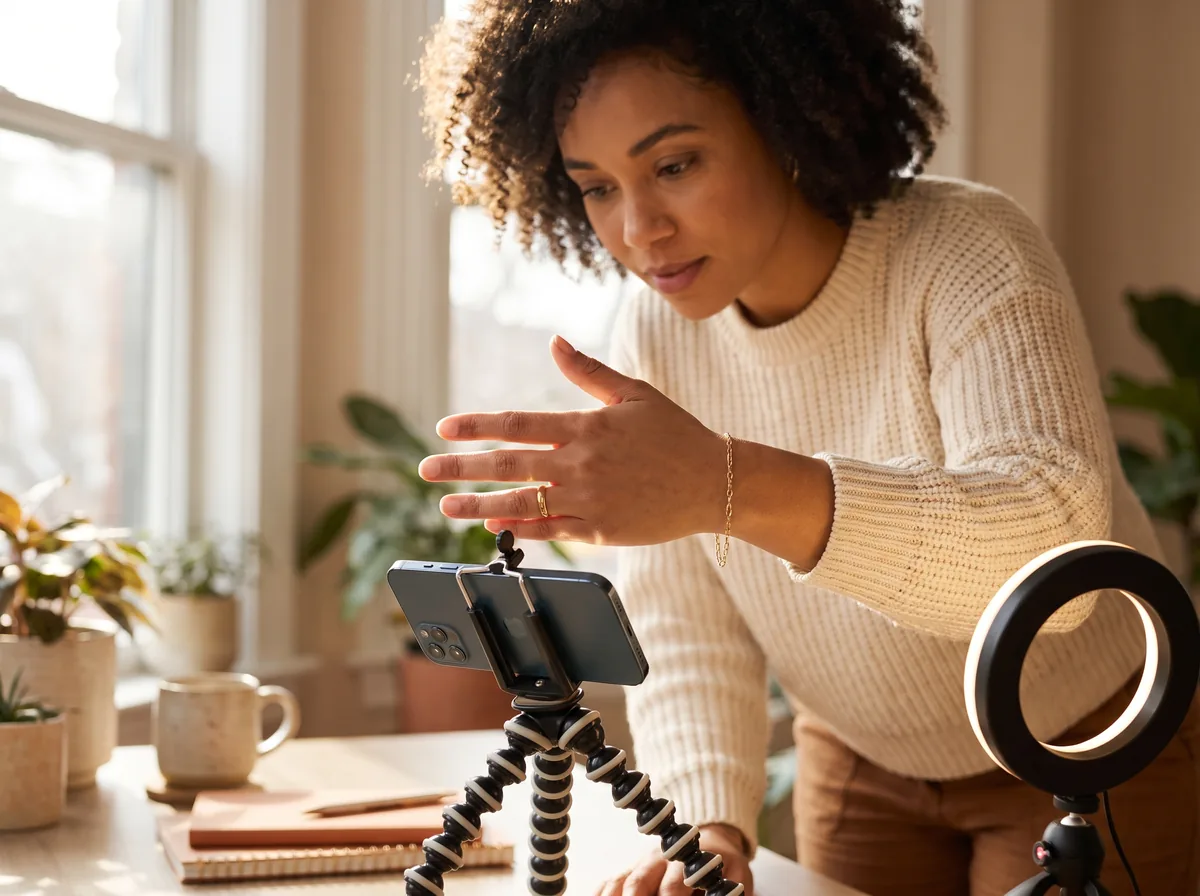
Window light, a phone on a tripod, and the piece on a real hand.
- Soft daylight from one side, so metal shows a clean highlight instead of a mirror of the room
- The piece on skin within the first two seconds, because scale is the question every buyer has
- A plain sleeve or top behind a chain or bracelet, never a busy print
- A ring light kept off axis, so it does not show up as a white circle in every stone
Brief in a minute
First one free
Why it works
What you get with jewelry ad briefs
Shot list for small, shiny things
The brief names every shot: the on-hand hook, the macro that catches light, the scale reference and the clasp or detail shot, with the light and background for each.
Claims you can defend
The script only uses the metal, stone and plating facts you give us, in the terms the FTC Jewelry Guides allow, so a creator does not improvise "solid gold" or "real diamond".
Try it before you pay
The first brief needs no account. Pro is $49 a month for unlimited briefs and scripts with clean downloads.
What it covers
The brief, the hook, and the shot-by-shot script
UGCMarketplace turns a product description into a written brief and video script you can hand to a creator you hire. It writes the words; you hire the creator.
- Get a hook built on the piece being worn in the first two seconds, with two alternates to test
- Get the scenes with timecodes, the voiceover and the on-screen text for sound-off viewing
- Get the product facts written in the exact terms to use, such as 14k gold plated or lab-grown diamond
- Get a 9:16 spec for TikTok, Reels, Shorts or Meta feed, with light and background notes
- Get a profile of the kind of creator to cast, and the usage rights to agree before filming
- Brief
- Jewelry ad briefs
- Creator to recruit
- Persona + where to find them
- Format
- Vertical 9:16, 0:20
- Script
- Hook, timed scenes, CTA
- Delivered in
- About a minute
What you get
Yours to useAn example of the written brief and script the generator produces. You take it to a creator you hire yourself.
In depth
What to know about jewelry ads
What makes jewelry ads work on Facebook and Instagram?
Scale, light and a reason. The buyer scrolling Facebook or Instagram cannot hold the piece, so the ad has to answer the three questions they would answer in a store: how big is it on me, does it actually sparkle, and why buy it today.
That is why the jewelry ads that hold attention are almost never the studio shot on white. They open on skin: a hand turning in window light, a necklace going on in a mirror, a stack being built one ring at a time. The close-up comes second, once the viewer knows what they are looking at. The reason comes last and is concrete: an anniversary, a gift under a price, a piece that survives the shower.
| Format | What the viewer sees first | Best for |
|---|---|---|
| Try-on | The piece going on, then the reveal | Earrings, necklaces, first-time buyers |
| Stack build | Rings or bracelets added one by one | Demi-fine brands selling several pieces per order |
| Gift reveal | The box opened by the person receiving it | Holidays, Valentine's Day, anniversaries |
| Wear test | The piece in water, at the gym, after a week | Claims about tarnish or daily wear, if you can back them |
| Detail close-up | Macro of the stone, clasp or engraving | Fine jewelry, custom and personalized pieces |
What does the FTC say about jewelry advertising?
More than most brands expect. The FTC's Guides for the Jewelry, Precious Metals, and Pewter Industries, 16 CFR Part 23, state that they "apply to claims and representations about industry products included in labeling, advertising, promotional materials, and all other forms of marketing". A creator's voiceover in your paid ad is advertising. These are the terms the Guides define, read on the Cornell LII copy of the regulation on 28 September 2026.
| Word in the ad | What it has to mean | Section |
|---|---|---|
| 14k gold, 18k gold | The karat mark must correctly precede the word gold for any alloy under 24 karats | 23.3 |
| Gold filled | Gold alloy of at least 10 karat making up at least 1/20th of the weight of the metal | 23.3 |
| Gold plate, gold electroplate | At least 0.175 microns of fine gold throughout | 23.3 |
| Heavy gold electroplate | At least 2.5 microns of fine gold throughout | 23.3 |
| Vermeil | Sterling silver base, gold of at least 10 karat, at least 2.5 microns | 23.4 |
| Sterling, sterling silver, solid silver | At least 925/1,000ths pure silver | 23.5 |
| Coin silver | At least 900/1,000ths pure silver | 23.5 |
| Lab-grown diamond | A qualifying word such as laboratory-grown or laboratory-created, next to the word diamond | 23.12 |
| Real, genuine, natural, precious | Not allowed on anything manufactured or produced artificially | 23.27 |
The practical point for a UGC ad is simple. The creator does not know your metal spec, so they will describe the piece the way it looks. Gold-colored reads as gold, clear stones read as diamonds. The brief fixes the wording before filming, which is far cheaper than recutting a voiceover after the ad is live.
How do you describe lab-grown diamonds in an ad?
Put a qualifying word right next to the word diamond, every time it is spoken or shown. Section 23.12 of the Jewelry Guides lists laboratory-created, laboratory-grown, [manufacturer name]-created, or another word or phrase of like meaning, and says the disclosure must make clear the product is not a mined stone and sit in immediate conjunction with the word diamond.
In a creator video that has two consequences. The spoken line cannot drift to plain "diamond" halfway through, which is exactly what happens when a creator gets excited on the second take. And the on-screen text has to carry the qualifier too, because a large share of viewers watch with the sound off. The brief writes both, and marks the lines the creator must read as written rather than paraphrase.
The same care applies the other way. Section 23.27 says real, genuine and natural cannot describe anything manufactured or produced artificially, so "a real diamond, just grown in a lab" is the one line a lab-grown brand should keep out of the script.
How do you film jewelry for a video ad?
Diffused light from one side, the piece on skin, and a phone close enough to focus. Jewelry fails on camera for three repeatable reasons: hard light turns metal into a mirror, autofocus hunts on a small object, and a busy background swallows a fine chain. A creator's usual setup, a ring light pointed straight at the face, makes all three worse.
| Shot | Time | How the brief specifies it |
|---|---|---|
| Hook on skin | 0 to 2s | Hand, ear or neck already wearing the piece, moving slightly so the light travels across it |
| Scale reference | 2 to 6s | Next to a fingertip, a coin or a familiar object, so the size is obvious |
| Macro close-up | 6 to 10s | Phone locked on focus, window light from the side, one slow turn |
| Detail | 10 to 14s | Clasp, hallmark, engraving or setting, whatever justifies the price |
| Reason and CTA | 14 to 20s | The occasion or the wear promise, then where to buy |
One rule the brief states outright: no beauty filter or color grade that changes the metal or stone color. Section 23.1 of the Guides treats misrepresenting a product's color as deception, and a warm filter that turns silver-tone into gold-tone is exactly that. A note to the same section covers the macro shot: a depiction that shows a gemstone larger than its actual size needs a disclosure, so the brief pairs every close-up with the scale shot before it. For still images of the same pieces, see product photography for ads.
How long should a jewelry video ad be?
Fifteen to twenty-five seconds for a direct-response cut, with the piece worn in the opening two seconds. The platforms allow far longer: Meta's ads guide permits Instagram Reels ads up to 15 minutes and sets no maximum on Facebook Reels. Length is not the constraint. Attention is.
Jewelry has an advantage here that most categories do not. The product is visible and beautiful in a single frame, so the ad does not need a long setup. Get the piece on skin, show the close-up, give the reason and stop. A longer cut earns its place only when there is a story to tell: a custom engagement ring, an heirloom redesign, a founder explaining where the stones come from.
We do not quote a view-through or conversion rate for a particular length, because we have not measured one. The full Reels specs, including the 14% top and 35% bottom safe zone that matters for price text, are on Instagram Reels ads.
Jewelry commercial or UGC jewelry ad, which should you make?
Usually both, for different jobs. A studio jewelry commercial, a turntable spin or a 360 video on a clean background, is the right asset for the product page, the marketplace listing and a retargeting ad aimed at someone who already knows the brand. A creator video is the right asset for cold traffic on Facebook, Instagram and TikTok, where a polished spot is recognized as an ad and skipped.
| Studio jewelry video | Creator jewelry ad | |
|---|---|---|
| What it shows | The piece, perfectly lit, on a turntable or model | The piece being worn by a person, in real light |
| Where it works | Product page, listing, retargeting | Cold paid social, Reels, TikTok, Stories |
| How it is priced | Per video or per spin by the studio | Creator fee plus usage rights for paid ads |
| What goes wrong | Looks like an ad, gets skipped in the feed | Wrong wording, bad focus, piece lost in the frame |
We compared what US jewelry video studios publish per video in jewelry videography pricing. On the creator side, the fee is only half of it. Agree how long you can run the ad as paid media before filming; the terms to settle are on UGC usage rights.
What should a jewelry ad brief include?
Everything the creator would otherwise guess. A jewelry brief that is only "show the ring, keep it natural" produces a video you cannot run. This is what the generator writes for a jewelry piece.
| Section | What it fixes |
|---|---|
| Product facts | Metal, karat or fineness, plating and thickness if known, stone and whether it is lab-grown, exactly as you want them said |
| Hook and alternates | The opening line and the opening frame, plus two more to test |
| Shot list | Each shot with timecode, light direction and background |
| Words to avoid | Real, genuine, solid gold, waterproof or hypoallergenic, unless you supplied the facts that support them |
| On-screen text | The lines for sound-off viewing, kept inside the platform safe zone |
| Creator profile | The kind of person to cast, their style and the skin tone or hand type the piece is designed for |
| Rights | How long and where you will run the video as an ad |
The generator writes words. It does not check your product against the Guides or approve an ad, so the facts it uses are the ones you enter.
Can a creator say waterproof or tarnish-free in a jewelry ad?
Only if you can back it up. Waterproof, tarnish-free, hypoallergenic and nickel-free are among the most common lines in demi-fine jewelry ads, and none of them is defined in the Jewelry Guides. They fall under the FTC's general rule that advertising claims must be truthful and substantiated, and Section 23.1 of the Guides separately treats misrepresenting a product's durability or metallic content as deceptive.
In practice, a creator who has worn a plated ring in the shower for a week has one experience, not a test. If your plating is thin, the same ring may look very different on a customer in three months, and the ad made a promise on your behalf.
The brief handles this by making the claim a field you fill in rather than something the creator improvises. If you enter a durability claim and what supports it, the script uses it with that support. If you leave it blank, the script talks about how the piece looks and feels, which sells jewelry perfectly well. For wear tests shown on camera, the rules for showing results are on before and after ads, and the placement rules for Meta are on UGC for Meta ads.
Why UGCMarketplace
Written, specific, and ready to hand over
Not a blank document, not a vague one-line brief, not a slow agency round trip. The brief and the script, written in about a minute.
The persona to recruit
The archetype, niche, account signals, search terms and outreach angle for the creator to look for. Finding and hiring them is your job, not ours.
Briefs you own
The briefs and scripts you generate are yours to use commercially. We claim no ownership and we do not resell your inputs.
Written for the platform
Pick TikTok, Reels, Shorts or Meta and the script, length and technical specs are written for that format.
Good questions
Questions about jewelry ad briefs
Explore more
More UGC briefs and scripts you can generate here
TikTok hooks
Describe your product and get the 0 to 3 second hook, the scenes that follow it, and the creator profile to recruit.
Learn more →Testimonial video scripts
The guides ranking for this phrase offer 5 to 36 questions. A 90 second cut holds about five answers.
Learn more →Testimonial video services
Seven companies, three published price lists, and one surcharge that barely moves.
Learn more →Get the brief written, free.
Describe your product and get the brief, the hook, the scene-by-scene script and the creator persona to recruit. First one needs no account.
written brief, AI-labelled, you hire the creator